

When people think about the Titanic, they often picture the massive ship sinking into the icy Atlantic Ocean on that tragic night of April 15, 1912. But did you know that more than 700 people actually survived the disaster?
Let’s dive into the story of the Titanic survivors, the brave passengers and crew who lived to tell the tale, and the incredible ship, the RMS Carpathia, that came to their rescue.
Table of Contents
The Titanic: The “Unsinkable” Ship That Sank
The RMS Titanic was one of the biggest and most luxurious ships ever built at the time. It was called “unsinkable” because of its advanced design, which included watertight compartments meant to keep it afloat even if the hull was damaged.
But when the Titanic hit an iceberg during its very first voyage from Southampton to New York City, everything changed. The “unsinkable” ship began to sink. Read about the reasons why the Titanic sank here.
There were 2,240 people on board — passengers, crew, and even a few pets! Sadly, only around 710 people survived.
A Freezing Ocean and a Race Against Time
When the ship hit the iceberg, the water temperature was below freezing — about –2°C (28°F). Many passengers didn’t stand a chance once they entered the icy ocean.
The Titanic didn’t have enough lifeboats for everyone on board. It carried only 20 lifeboats, which could hold about 1,178 people — not nearly enough for all passengers and crew.
Even worse, some lifeboats were launched half-empty because people didn’t realize how serious the situation was.
Enter the Hero Ship: RMS Carpathia
Here’s where the RMS Carpathia comes in—the real hero of the story!
The Carpathia was a smaller passenger ship sailing nearby. When the radio operator received Titanic’s SOS distress signal, the captain, Arthur Rostron, immediately ordered his crew to change course and head full speed toward the sinking ship.
💡 Fun fact: The Carpathia was about 58 miles (93 km) away when it got the distress call. Even though there were icebergs in the water, the crew pushed the ship to its maximum speed and arrived about 2 hours after the Titanic sank.
When they reached the site, they found hundreds of survivors in lifeboats, shivering, scared, and exhausted. The crew of the Carpathia pulled every survivor aboard, gave them warm blankets, food, and comfort, and safely took them to New York City.
That’s how the survivors’ story continued.
Famous Titanic Survivors You Should Know
1. Molly Brown – “The Unsinkable Molly Brown.”
Molly Brown was a brave first-class passenger who helped row a lifeboat and kept everyone’s spirits up. After being rescued by the Carpathia, she helped organize aid for poorer survivors. That’s why she’s called “The Unsinkable Molly Brown”. Read about her amazing story in this article.
2. Millvina Dean – The Youngest Survivor
Millvina Dean was just 2 months old when she was rescued. She grew up to become the last living survivor of the Titanic—she lived until 2009!
3. Charles Lightoller – The Heroic Officer
Second Officer Lightoller helped passengers get into lifeboats and was one of the last people to leave the ship. He survived by clinging to an overturned lifeboat.
4. Mrs Lily Alexenia Potter
August 15, 1855 – January 1, 1954
Lily Alexenia Wilson was born in Michigan, United States. She was the daughter of Seth Wyle Wilson and Martha A. Thompson. During her youth, her family eventually relocated to Philadelphia, Pennsylvania, where Lily would spend much of her adult life.
Growing up during the mid-19th century, Lily witnessed dramatic changes in American society, including industrial expansion, social transformation, and technological advancement. Philadelphia, at the time, was a growing center of culture and commerce, offering opportunities for influential families to establish themselves socially and financially.
In 1876, Lily married Thomas Potter Jr., a wealthy and influential businessman from Philadelphia. The couple built a comfortable and respected life together in Mt. Airy, Pennsylvania, an affluent suburb north of Philadelphia. They had three children:
- Wilson Potter
- Thomas Potter III
- Olive Potter
Unfortunately, in 1894, their eldest son, Thomas III, died at just 17 years old. Later, in 1910, Colonel Thomas Potter Jr. passed away at the age of 60, leaving Lily widowed.
Following the death of her husband, Lily sought to support her daughter, Olive, whose marriage to Boulton Earnshaw was collapsing. Hoping to provide comfort and distraction during Olive’s difficult divorce proceedings, Lily arranged a lengthy European vacation for herself and her daughter.
Joining them on the trip was Margaret Bechstein Hays, Olive’s close friend from Briarcliff School in New York. The three women toured parts of Europe and the Middle East, enjoying an extended journey abroad.
Originally, the group had booked passage home on another vessel. However, while in Turkey, they learned about the magnificent new White Star liner called the Titanic. Fascinated by the ship’s luxury and worldwide publicity, they postponed their return and purchased first-class tickets aboard the RMS Titanic instead. They paid 83 pounds each for the ticket.
On April 10, 1912, Lily Potter boarded the RMS Titanic at Cherbourg, France. She traveled as a first-class passenger under ticket number 11767 and was assigned cabin C-50. Olive Potter and Margaret Hays shared the nearby cabin C-54.
At approximately 11:40 p.m., the Titanic collided with an iceberg in the North Atlantic Ocean. Lily had not fully fallen asleep when she felt the ship shudder violently. Shortly afterward, the engines stopped.
Olive and Margaret soon came to Lily’s cabin after investigating the disturbance. Although crew members attempted to reassure passengers that there was little danger, Lily immediately sensed the seriousness of the situation.
Later, she recalled:
“I was the most alarmed of our party.”
Unlike many passengers who initially dismissed the danger, Lily acted quickly and decisively. She instructed Olive and Margaret to put on warm undergarments and prepare to leave their cabins. Remarkably, the women decided not to wear corsets because Lily feared they might interfere with swimming if necessary.
Lily, Olive, Margaret, and their acquaintance Gilbert Milligan Tucker Jr. made their way to the boat deck carrying blankets and Margaret’s small Pomeranian dog wrapped inside them.
They eventually boarded Lifeboat 7, the very first lifeboat launched from the Titanic at approximately 12:45 a.m. At that point, many passengers still refused to enter the boats because they did not believe the ship was in serious danger.
Lily later recalled hearing confusion among passengers as crew members attempted to encourage people into the lifeboats.
Because the boat was not full, Gilbert Tucker was also permitted aboard to accompany the women.
Hours later, the RMS Carpathia arrived to rescue Titanic survivors.
Exhausted and freezing, Lily struggled to climb the rope ladder onto the rescue ship. According to reports, she became too cold to grip the ropes properly and instead used a rope swing to board the Carpathia safely.
5. Jack Thayer
Jack Thayer was not just another passenger aboard the RMS Titanic. He came from one of America’s wealthy and influential families during the early 1900s. Born as John Borland Thayer III in Philadelphia on December 24, 1894, he grew up surrounded by privilege, elite education, and social prominence. His father, John Borland Thayer II, served as a high-ranking executive with the Pennsylvania Railroad Company, a position that carried immense prestige in that era. To many people of the time, the Thayer family represented success, stability, and upper-class American society.
The Thayer family boarded the Titanic during a return trip from Europe in April 1912. Traveling with Jack were his parents and the family maid, Margaret Fleming. They sailed as first-class passengers, enjoying all the luxuries that the Titanic proudly offered to elite travelers. For a 17-year-old like Jack, the journey likely felt magical at first. He later recalled the beauty of the ocean and the peaceful atmosphere before the collision. One quote often associated with his memories described the evening as “the kind of night that made one glad to be alive.” The irony of those words is haunting because, only hours later, the same peaceful sea became a graveyard for more than 1,500 people.
What makes Jack’s experience especially emotional is that the disaster shattered his family forever. His mother survived, but his father did not. That single night permanently divided his life into two versions: the carefree world before the Titanic and the emotionally scarred world afterward. Decades later, Jack would write that the sinking felt like the moment the modern world “awoke.” Those words reveal how deeply the event affected his view of humanity and history itself.
Jack Thayer later described subtle details from the night of April 14, 1912, that were burned into his memory forever. He noticed the unusual stillness of the sea and the freezing cold air. Survivors often recalled how calm the Atlantic looked that night, almost like glass. Ironically, that calmness made spotting icebergs more difficult because no waves were crashing against them to create visible foam. (Read the science behind this calm night in our article analyzing why the Titanic sank.)
He later made this drawing to help others understand how the mighty, unsinkable ship went down.
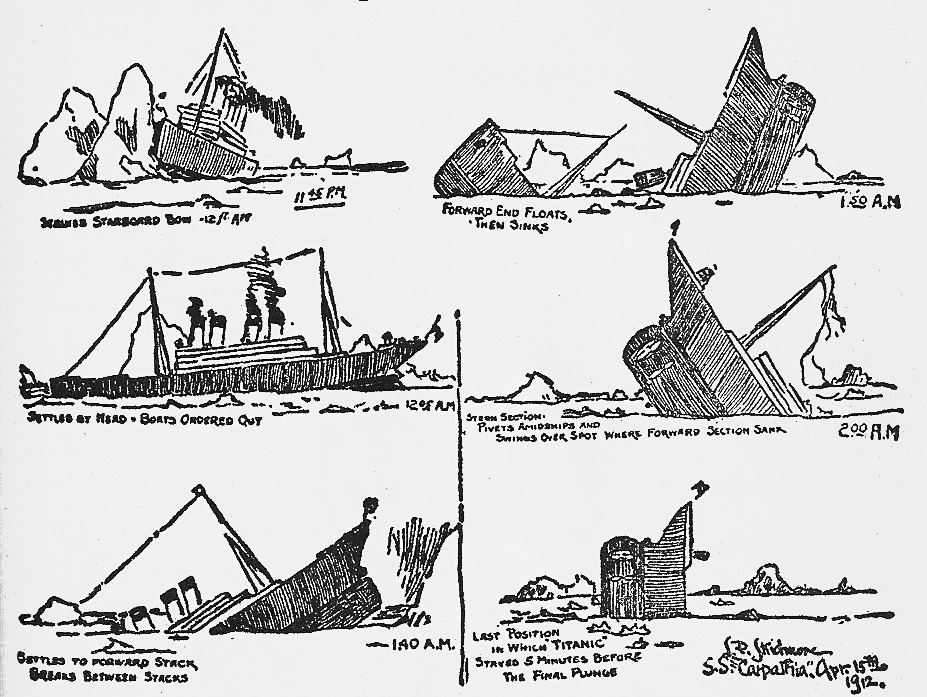
Jack found himself alongside another passenger named Milton Long during the Titanic’s final moments. The two young men discussed whether they should remain on board or jump into the sea. Long reportedly advised caution because the freezing water was deadly, but eventually they realized staying aboard meant certain death. Jack decided to jump clear of the ship rather than slide down its side, a decision that likely saved his life.
Swimming in those conditions required extraordinary determination. The ocean was filled with debris, terrified passengers, and deadly freezing water. Jack managed to reach Collapsible Lifeboat B, one of Titanic’s emergency collapsible boats that had overturned during launch. Instead of sitting inside it, survivors balanced precariously on top of the upside-down boat for hours.
Eventually, other lifeboats rescued those still alive on Collapsible B. Jack was later transferred to Lifeboat 12 and eventually rescued by the RMS Carpathia.
6. Mr. Charles Eugene William
Charles Eugene Williams was born on July 28, 1888, in Brompton, London, England. He grew up in a working-class family with Welsh roots, far removed from the luxury associated with the Titanic’s elite passengers. His father worked as a tailor, and the family lived modestly in London during the late Victorian period. Despite these humble beginnings, young Charles displayed unusual determination and competitive spirit from an early age. Those traits would eventually shape both his sports career and his ability to survive the Titanic catastrophe.
Charles Williams rose rapidly through the competitive sporting ranks in England. In 1911, he captured the Open Championship of England and soon after secured the world racquets title. For a young man from modest origins, this achievement was enormous. Sports during the early twentieth century were deeply tied to class systems, and elite clubs were often dominated by wealthy aristocrats. Williams broke through those barriers through pure talent and determination.
It was this sporting success that ultimately placed him aboard the Titanic. Charles Williams boarded in Southampton as a second-class passenger with a ticket costing £13, a considerable amount at the time. His destination was Chicago, where sporting opportunities awaited him.
Most men on the Titanic were not allowed into lifeboats because of the “women and children first” policy. But Charles Williams appears to have been allowed into RMS Titanic sinking Lifeboat No. 14 specifically because Fifth Officer Harold Lowe wanted strong men who could row and help with rescue operations.
Historical testimony suggests Williams was selected because he was athletic, physically powerful, and useful to the crew. He was a world-class racquets champion, so he would have been seen as exceptionally fit.
TheEncyclopedia Titanica states:
“…second-class passenger Charles Williams, whom Lowe took for rowing before the boat was lowered away…”
There’s also an interesting historical contradiction surrounding Williams. Some later reports claimed he had been swimming in the water before reaching the lifeboat, but Officer Lowe’s testimony reportedly indicates Williams actually boarded directly from the Titanic deck before launch.
Fun Activity: Design Your Own Rescue Ship!
Imagine you’re the captain of your own rescue ship.
- What would you name it?
- How would you make it strong enough to travel through icy waters?
- Would it have radar, lifeboats, or underwater robots?
Draw your ship, name your crew, and write a short story about your rescue mission!
Final Thoughts
The story of the Titanic survivors isn’t just about tragedy—it’s about bravery, teamwork, and compassion. From the courageous passengers who helped others to the quick-thinking crew of the RMS Carpathia, it reminds us that even in the darkest nights, there are heroes who shine.
