

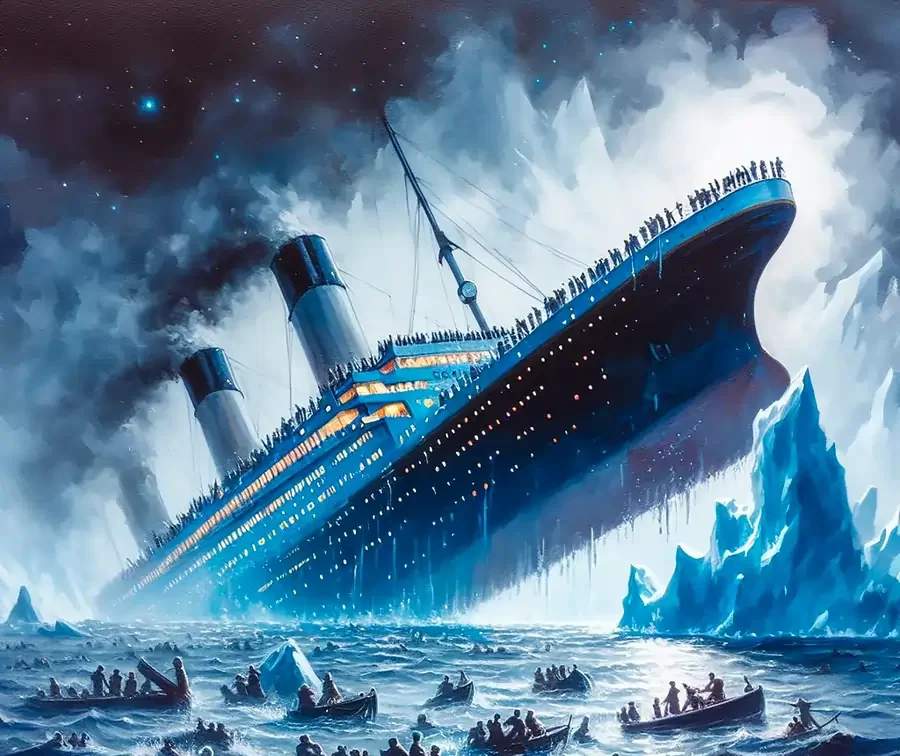
On April 14, 1912, the RMS Titanic was moving through the North Atlantic at close to full operating speed, despite multiple ice warnings received earlier that day.
The ship was under the command of Edward Smith, a highly experienced captain nearing the end of his career. Nothing about the situation seemed urgent enough to demand a major change. Transatlantic liners were expected to maintain speed, and it was said that the Titanic’s design was such that it was able to cover more distance in a shorter time.
It was widely described as “the unsinkable ship.” Purely because, unlike other ships of the time, it was capable of staying afloat even if up to four of its compartments got flooded.
Table of Contents
The Moment the Iceberg Was Seen
At 11:40 PM, the lookout, Frederick Fleet, spotted an iceberg ahead.
The message reached the bridge, where the first officer, William McMaster Murdoch, responded to Frederick Fleet’s call. His actions were immediate:
- Hard turn to avoid the iceberg
- Engines reversed
These were standard emergency responses. And at first, it felt that the correct decision had been made as the ship steered away from the iceberg. But William Murdoch had no way of knowing about a part of the iceberg that was jutting out, causing the ship to brush against it.
What Passengers Actually Felt
Since the Titanic did not crash into the iceberg, there was no crash. Thesurvivors of the Titanic described feeling a faint vibration.
Which is why most of the people on board did not treat it as a disaster.
What Happened Below the Waterline
The iceberg made contact along a stretch of the hull, placing stress on multiple points. Instead of one large hole, there were a series of small openings created along the ship’s side.
In freezing temperatures, the steel used in the hull became less flexible. Under stress, it was more likely to fracture than bend. Rivets holding the steel plates in place loosened or failed, allowing seams to open.
Individually, none of these breaches seemed large. Together, they became catastrophic.
A Design That Led To Progressive Flooding
The Titanic was built with watertight compartments, a feature that contributed to its reputation for safety. The idea was straightforward: if one part of the ship flooded, the rest could remain intact.
And under other conditions, this design would have worked.
The ship could stay afloat if up to four compartments were breached.
That night, at least five compartments were compromised.
There was another limitation. The walls between compartments did not extend all the way up. As water filled the front sections, it began to spill over into the next ones, like liquid moving across a series of connected containers.
As water entered the forward compartments, the bow of the ship began to dip. This shift changed the balance of the entire structure.
Once the angle increased, water flowed more easily from one compartment to the next.
This is what’s known as progressive flooding.
As the bow sank deeper, the stern lifted out of the water. This placed enormous stress on the ship’s structure.
Ships are not designed to support themselves in this position for long. The forces acting on the hull became uneven and extreme.
Eventually, the structure gave way. The Titanic broke apart and sank.
Human Errors That Contributed to the Disaster
1. The Lifeboat Shortage
Although the Titanic carried lifeboats, there were only enough spaces for about half the people on board. At the time, maritime regulations were outdated and based on ship tonnage rather than passenger capacity.
The Titanic carried 20 lifeboats, each capable of holding approximately 1,178 people, while more than 2,200 passengers and crew were on board.
Even worse, many lifeboats launched partially empty during the early stages of evacuation because passengers initially believed the ship was safe. Some people were reluctant to leave the warm, brightly lit vessel for small boats in the freezing darkness.
This tragic misunderstanding cost hundreds of lives.
2. Ignoring Ice Warnings
Several iceberg warnings sent by nearby ships never reached key officers. Communication failures and radio operator priorities contributed to the problem.
Wireless operators were busy sending passenger messages, and some ice warnings were not treated with sufficient urgency.
3. Excessive Speed
The Titanic traveled at nearly full speed through an area known for dangerous ice conditions. Slowing down could have provided additional reaction time and potentially prevented the collision.
4. Poor Binocular Access
One of the most frequently discussed details surrounding the sinking of the RMS Titanic was the absence of binoculars for the lookouts stationed in the crow’s nest. While the missing binoculars did not directly cause the disaster, the incident has become a powerful example of how a seemingly minor oversight can contribute to a catastrophic outcome.
The Titanic’s lookout crew, including Frederick Fleet, depended entirely on their eyesight to scan the freezing North Atlantic for icebergs and other hazards. On a moonless night with calm seas and limited visibility, this task was already extremely difficult. Normally, binoculars could assist lookouts in identifying distant objects more clearly, especially in dangerous waters known for drifting ice.
The problem reportedly began just before the Titanic departed Southampton. A last-minute personnel reshuffle resulted in Officer David Blair being removed from the voyage and replaced by another officer. In the confusion of the transfer, Blair accidentally left the ship carrying the key to a storage locker that contained the binoculars assigned to the lookout station.
Without access to the locker, the crow’s nest crew sailed without binoculars for the entire voyage.
This small administrative mistake has often been connected to the principles of chaos theory, sometimes referred to as the “butterfly effect.” Chaos theory suggests that tiny events can trigger enormous and unpredictable consequences later on. In the Titanic’s case, a simple forgotten key may have become one small link in a chain of events leading to one of history’s deadliest maritime disasters.
Historians debate how much difference binoculars would actually have made. Some experts argue that binoculars may not have significantly improved visibility that night because the iceberg blended into the dark horizon under unusual atmospheric conditions. Others point out that binoculars narrow a person’s field of view, which can sometimes make scanning wide areas more difficult.
However, others believe even a few extra seconds of warning could have mattered. The Titanic was traveling at high speed, and the crew had very little time to react after the iceberg was spotted. Detecting it slightly earlier may have allowed officers to turn the ship more effectively or reduce the force of the collision.
Frederick Fleet later stated during official inquiries that he believed binoculars could have helped the lookouts identify the iceberg sooner. His testimony fueled decades of debate about whether one forgotten key indirectly influenced the fate of the Titanic.
5. The Role of the Nearby Ship Californian
Another controversial aspect of the disaster involves the nearby ship SS Californian.
The Californian was relatively close to the Titanic during the sinking but failed to respond in time. Its wireless operator had gone to sleep shortly before distress signals were sent.
Crew members aboard the Californian reportedly saw rockets in the distance but did not fully understand their significance.
Had the Californian acted sooner, many more lives might have been saved.
The Role of Weather and Ocean Conditions
Why the Iceberg Was Difficult to See
The night of the collision presented unusually dangerous viewing conditions.
The sea was exceptionally calm, meaning no waves were breaking against the base of the iceberg. Normally, white water from crashing waves would make icebergs easier to spot at night.
Additionally, there was no moonlight. The darkness reduced visibility significantly.
Cold atmospheric conditions may also have created dangerous optical illusions that distorted the horizon and reduced visibility for the lookouts aboard the RMS Titanic. Experts believe a phenomenon known as a thermal inversion may have occurred that night. This happens when a layer of extremely cold air sits close to the ocean surface while warmer air remains above it. The unusual temperature difference bends light rays abnormally, similar to how a mirage forms in a desert.
As a result, the horizon may have appeared blurred, raised, or distorted, making it much more difficult for the crew to judge the iceberg’s true distance and size accurately. The iceberg itself could have blended into the dark horizon rather than standing out clearly against the night sky. Some researchers also believe the distorted light conditions may have delayed the visibility of the iceberg until it was dangerously close to the ship.
The same atmospheric conditions may have affected nearby ships as well. Lights from vessels in the distance could appear misplaced, stretched, or deceptively far away. This may help explain why distress rockets fired from the Titanic were misunderstood by the crew of the SS Californian, which was nearby but failed to respond quickly enough.
Combined with the moonless night and unusually calm sea, these atmospheric distortions created one of the worst possible environments for detecting icebergs in the North Atlantic Ocean.
How the Titanic Broke Apart
For decades, many people believed the Titanic sank intact. However, discoveries made after the wreck was found revealed the truth.
As the bow filled with water, tremendous stress developed in the middle of the ship. Eventually, the Titanic split into two major sections before sinking completely.
The bow section descended first, followed by the stern.
The wreck was finally discovered in 1985 by oceanographer Robert Ballard and his team approximately 12,500 feet below the ocean surface.
Why So Many People Died
Freezing Water Temperatures
The North Atlantic Ocean was lethally cold, with water temperatures around 28°F (-2°C).
Most victims died from hypothermia within minutes after entering the freezing water.
People trapped onboard faced terrifying conditions as the ship tilted sharply upward before disappearing beneath the ocean.
Class Differences During Evacuation
Social class played a major role in determining who survived the sinking of the RMS Titanic. Although the disaster affected passengers from every background, survival rates were heavily influenced by cabin location, access to the boat deck, communication barriers, and the ship’s internal design. The Titanic was built with strict separation between passenger classes, reflecting the social hierarchy of the early 20th century. First-class passengers occupied luxurious cabins on the upper decks, while many second-class and third-class passengers were located much lower in the ship. Third-class accommodations, often called steerage, were deep within the vessel near the lower decks and engine areas.
This arrangement became extremely dangerous once the evacuation began.
One of the most controversial aspects of the disaster involves the barriers and gates separating third-class passengers from the rest of the ship. Contrary to popular belief, these gates were not originally designed to imprison passengers. Many existed because of American immigration laws requiring separation between classes to reduce the spread of infectious diseases during ocean crossings. However, during the chaos of the sinking, these barriers created serious obstacles for passengers trying to escape.
Some survivor testimonies described locked gates, closed passageways, and crew-controlled access points that delayed movement from the lower decks. Other survivors reported confusion while trying to navigate the Titanic’s complicated corridors and staircases. The ship was enormous and difficult to navigate even under normal conditions, especially for passengers unfamiliar with its layout. Many third-class passengers became trapped in a maze of hallways as water rapidly flooded the lower sections of the ship.
Language barriers made the situation even worse. Many third-class passengers were immigrants traveling to America from countries across Europe and the Middle East. Some spoke little or no English, making it difficult to understand emergency instructions shouted by crew members. In the confusion, some families reportedly stayed in their cabins too long because they did not fully realize the seriousness of the collision.
Meanwhile, first-class passengers had major advantages. Their cabins were located much closer to the boat deck, giving them faster and easier access to lifeboats. They also had better communication with officers and stewards who guided them during the evacuation. Elegant staircases connected first-class areas directly to the upper decks, while many third-class passengers had to search desperately for exits leading upward.
There is no clear evidence that the White Star Line intentionally ordered third-class passengers to be abandoned below deck. However, the combination of locked barriers, delayed access, confusing layouts, poor communication, and social inequality had devastating consequences. Even temporary delays became deadly because the Titanic sank in less than three hours.
The survival statistics reveal how severe these inequalities were. Approximately 62% of first-class passengers survived, compared to around 41% of second-class passengers and only about 25% of third-class passengers. Third-class men experienced some of the lowest survival rates aboard the ship.
The evacuation of the Titanic exposed how class divisions affected nearly every aspect of life in 1912, including the chances of survival during a disaster. When panic spread and time ran out, wealth, location, language, and access to information became critical advantages. The tragedy remains one of history’s clearest examples of how social inequality can magnify the human cost of catastrophe.
The Rescue by the Carpathia
The ship RMS Carpathia responded to the Titanic’s distress calls and rushed through dangerous ice fields to assist survivors.
Captain Arthur Rostron and his crew rescued more than 700 survivors from lifeboats during the early morning hours of April 15, 1912.
Their heroic actions prevented an even greater tragedy.
Changes in Maritime Safety After the Titanic
The sinking of the Titanic transformed international maritime safety laws forever.
Several major reforms followed the disaster:
- Ships were required to carry enough lifeboats for everyone on board.
- Continuous radio communication became mandatory.
- International iceberg patrols were established in the North Atlantic.
- Emergency evacuation drills became standardized.
- Safety regulations for ship construction were strengthened.
These changes dramatically improved passenger safety across the shipping industry.
The Titanic’s Enduring Legacy
More than a century later, the Titanic continues to fascinate historians, researchers, and the public. The disaster symbolizes both human ambition and human vulnerability.
Books, documentaries, museums, and films continue exploring every detail of the tragedy. The story endures because it combines luxury, heroism, sacrifice, engineering failure, and heartbreaking loss in a single historic event.
The Titanic was more than a ship. It became a warning about overconfidence, inadequate safety planning, and the dangers of ignoring nature’s power.
Even today, the question “Why did the Titanic sink?” reminds us how a series of small decisions can lead to one of history’s greatest disasters.
