

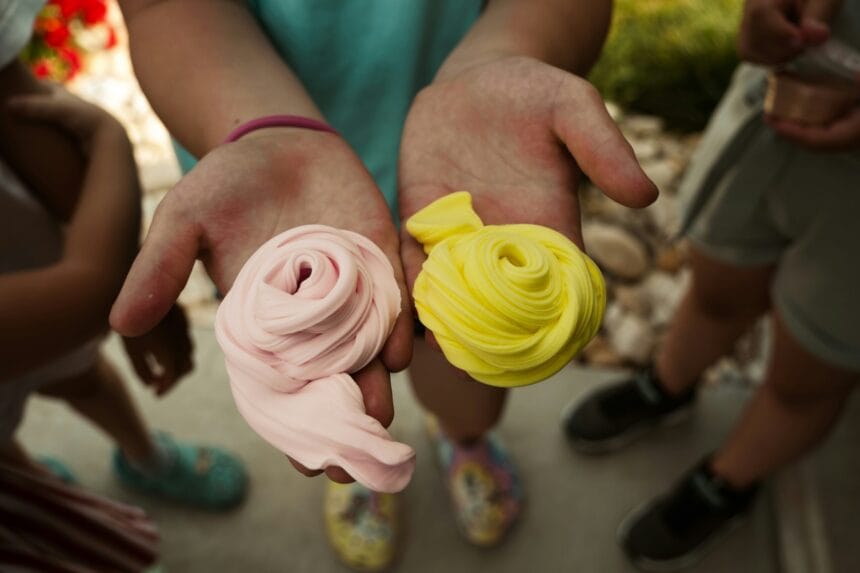
Let’s be honest.
You didn’t wake up thinking, “Today is the day I become a slime scientist.”
And yet… here we are. Holding glue. Questioning life choices. Hoping this doesn’t end in a sticky disaster.
Good news:
This is one of those rare activities where minimal effort = maximum child excitement.
Even better? It’s just 3 main ingredients.
This recipe contains PVA glue and activators, but if you don’t want to use it, check out our simple slime without glue and activator recipes here.
Table of Contents
What Is Slime, Really?
Slime is a non-Newtonian fluid, meaning it behaves both like a liquid and a solid depending on how you handle it. Pull it slowly—it stretches. Tug it quickly—it snaps.
This magical transformation happens because of a chemical process called cross-linking.
What You Need to Make Your Own Slime
- 1 cup white PVA glue
- 1/2 cup foaming hand wash
- Activator (add slowly)
Optional (if you’re feeling ambitious):
- Food color
- Fragrance oil
- Glitter (only if you’re emotionally ready for it)
Understanding the Key Ingredients
Before jumping into the recipe, it helps to know what each ingredient actually does.
1. PVA Glue
The “white glue” used in slime is usually PVA glue, short for polyvinyl acetate.
- It’s a type of plastic polymer (yes, technically, slime is soft plastic)
- Found in school glue and craft glue
- Safe and water-based
Why it matters:
PVA glue contains long, loose chains of molecules. On its own, it’s just sticky and runny. But when we add an activator, those chains link together—creating slime.
Quick but Important: Use the Right Glue
- Use only non-toxic glue (the kind labeled safe for kids)
- Avoid industrial or super glues (obviously, but still worth saying)
How to Check If Your Glue Will Actually Work
Not all white glues behave the same. If you’re unsure, do this quick test:
- Take a small drop of glue
- Let it dry completely
What you’re looking for:
- If it dries into a flexible, slightly rubbery film → it’s likely PVA (good for slime)
- If it dries brittle or cracks easily → it probably won’t work well
It’s a tiny step, but it can save you from a full “why is this not becoming slime” situation later.
2. Activators
An activator is what transforms glue into slime.
Common activators include:
- Borax solution
- Baking soda + contact lens solution (Just make sure your contact lens solution has boric acid or buffered saline listed in the ingredient list. Also, add some glycerin if you’re using this activator so that your slime does not develop that hard layer on top. )
- Liquid laundry detergent (Must contain boric acid or borate ion)
- Liquid Starch
What they do:
Activators contain borate ions, which connect (or “cross-link”) the PVA molecules. This creates a stretchy network—aka slime.
Important note:
Without an activator, you’ll just have a gooey mixture—not slime.
How much activator to add to my slime?
For this particular recipe,
Laundry detergent: 5-7 tbsp
Liquid starch: 6-8 tbsp
Baking soda + contact lens solution: First, add 1 tbsp of baking soda to your slime. Mix it. Then add 1-3 tbsp of contact lens solution.
3. Foaming Hand Wash
This is your secret weapon for:
- Softer slime
- More volume
- Fluffier texture
It doesn’t activate slime, but it:
- Dilutes the glue slightly
- Adds air
- Makes the slime smoother and more fun to stretch
The Slime Recipe (Tried and Tested)
Ingredients:
- 1 cup white PVA glue
- 1/2 cup foaming hand wash
- Activator (as needed)
- Optional: color, fragrance oil
Step-by-Step Instructions
Step 1: Start with Glue
Pour 1 cup of PVA glue into a bowl.
This is your base—everything builds from here.
Step 2: Add Foaming Hand Wash
Add 1/2 cup foaming hand wash and mix well.
You’ll notice:
- The mixture becomes lighter
- Slightly fluffy texture forms
Step 3: Add Color & Fragrance (Optional)
Now’s the time to:
- Add a few drops of food coloring
- Mix in fragrance oil (just a tiny amount!)
Stir until evenly combined.
Step 4: Add Activator (Slowly!)
This is the most important step.
- Add the activator of your choice a little at a time
- Stir continuously
Watch closely:
- The mixture will start pulling away from the bowl
- It becomes less sticky and more stretchy
Step 5: Knead the Slime
Once it starts forming:
- Take it out of the bowl
- Knead with your hands
At first, it may feel
- Sticky → keep kneading. If it’s too sticky to handle, dip your hands in the activator so the slime doesn’t stick to your hands, and keep kneading.
- Too stiff → you added too much activator
Step 6: Store in an airtight container
Store your slime in an airtight container so it does not dry out. If you let your slime rest for 3-ish days after making, your slime will develop that glossy feel.
Troubleshooting (Because Slime Can Be Moody)
“It’s too sticky.”
→ Add a tiny bit more activator
→ Knead before adding more
“It’s rubbery and stiff.”
→ Too much activator
→ Fix: add a bit more glue or hand-wash
“It’s not turning into slime.”
→ Your activator likely doesn’t have borate ions
→ Switch to a known working one
Safety Tips (Especially for Kids)
- Do not eat slime
- Wash your hands after playing
- Avoid contact with the eyes
- Store in an airtight container
