

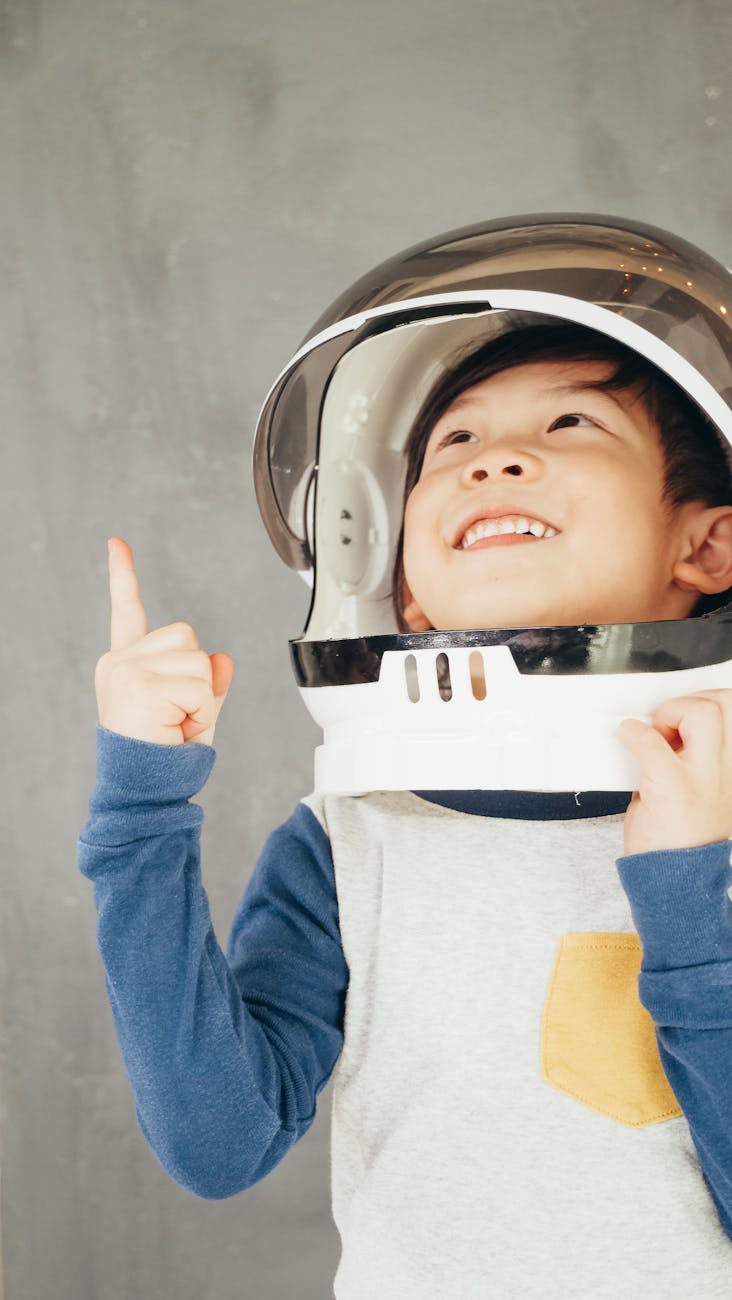
You’ve probably heard it before: pretend play is essential for your child’s development. Modern preschools schedule entire hours around it. Parenting experts urge us to make space for it at home.
But what if not every culture sees pretend play as that important?
In fact, many non-Western parenting styles don’t consider imaginative play a must, and their children turn out just fine.
So, are we missing something? Or has Western society put pretend play on a pedestal?
This study explores that very question, and in this article, we’ll unpack what it found.
Table of Contents
What is Pretend Play?
Pretend play is all about exploring the world of “what if.”
What if I were an astronaut? What if I were cooking burgers for my family today?
It can be a solo adventure—just your child and their imagination—or a social activity shared with friends. Most children start engaging in pretend play between the ages of 3 and 5, but it often continues into middle school and beyond.
Does Pretend Play Actually Support a Child’s Development?
To find out, the study reviewed a wide range of existing research that explored how pretend play affects different areas of a child’s development.
Here’s what it found:
1. Creativity
Pretend play is often credited with sparking creativity, but the evidence doesn’t quite back that up.
When researchers looked at the connection, the results were mixed. Some studies found a link (especially with social pretend play), while others didn’t see any relationship at all. And in the more carefully controlled experiments, where the researchers didn’t know which children were in the pretend play group, that creative boost disappeared entirely.
Interestingly, even when kids were given special pretend play sessions, they didn’t become any more creative than kids who practiced other types of skills. So while pretend play might feel imaginative and fun, it does not seem to have a strong or direct impact on creativity.
2. Intelligence
There’s some evidence that play and intelligence are linked in natural settings, but it’s still unclear which one drives the other.
When it comes to training studies, pretend play does not seem to have a stronger impact on boosting intelligence scores than other types of adult-guided interventions. In fact, music-based interventions showed more promise in raising intelligence scores than pretend play. This raises the possibility that certain aspects of adult interaction or the structure of music training could be the real contributors, rather than the play itself.
Future research could help clarify this by isolating those key features to see what really makes the difference.
3. Problem Solving
When it comes to problem-solving, construction play seems to be the winner, at least according to correlational studies. These studies found a link between construction play and the ability to solve related problems, while pretend play didn’t show the same connection.
But here’s the big question: Does construction play actually improve problem-solving skills, or is it just that kids who enjoy building things are naturally better at solving problems in general? Experimental studies have tried to answer this, but the results have been inconsistent. In fact, when researchers used stricter controls or masked experimenters, the link between play and problem-solving wasn’t as clear, suggesting other factors might be at play.
4. Logical Reasoning
One cognitive skill often tied to pretend play is the ability to solve logical syllogisms—problems where you reason from false premises. For example, “Dogs live in trees. Rex is a dog. Does Rex live in a tree?” The logically correct answer would be “yes,” but it’s tricky because you have to ignore real-world knowledge to accept the false premise.
Several studies have found that children perform better on these types of problems when they are framed as part of a fantasy scenario. For example, researchers might say, “Let’s pretend everything in this story is true” or use exaggerated pretend voices. However, some experts believe that these fantasy cues just help kids focus more carefully on the premises, rather than pretend play itself being the cause of improved reasoning.
The conclusion here? Pretend play might help children think through false premises, since that’s essentially what they do when they engage in imaginative play. But future research should explore whether pretend play boosts logical reasoning more broadly—or if other cues in the studies played a bigger role.
5. Conservation Skills
There’s no strong evidence to suggest that pretend play directly helps children develop conservation skills—the understanding that quantities stay the same even when their appearance changes.
For pretend play to be the cause, we’d need consistent evidence showing that it leads to better conservation abilities, but that’s not the case. While the idea of equifinality (the notion that different paths can lead to the same result) still holds, studies like Golomb’s suggest that conservation training works just as well. Interestingly, the improvements were actually linked to how adults guided the play, not the pretend play itself.
6. Theory of Mind (ToM)
At first glance, pretend play seems like it should help children develop Theory of Mind—the ability to understand that others have thoughts, feelings, and perspectives different from their own. But the evidence doesn’t strongly support this idea.
Some studies found a connection between pretend play and ToM, while others didn’t. Interestingly, one study even suggested the opposite: that children with more advanced Theory of Mind are more likely to engage in complex pretend play, not the other way around.
Many training studies have tried to test this link, but most had major flaws, and even the most well-designed one didn’t show any improvement in ToM from pretend play or skills training. Overall, it seems that while pretend play and Theory of Mind often show up together, it may be due to other factors, like the kinds of conversations kids have with adults who encourage both imaginative thinking and perspective-taking.
7. Social Skills
Does pretend play help children build better social skills? The research isn’t quite sure.
Some studies have found a connection between pretend play and social development, while others haven’t—making it hard to claim a clear cause-and-effect relationship. One interesting finding did show that drama-based training might improve social skills, but it’s unclear whether it was the pretending itself or something else, like increased interaction with others, that made the difference.
Pretend play might be one path to developing social skills, but it’s just as likely that both emerge from a deeper factor, like a child’s natural sociability or the way they interact with people around them.
8. Language Development
Pretend play and early language skills do seem to be connected—and interestingly, pretend play often shows up first.
Researchers believe this link might exist because both skills rely on symbolic thinking (like using one thing to represent another). That suggests the two could develop side by side, rather than one directly causing the other.
A cause-and-effect relationship is still possible, but it could also go the other way, where language development supports pretend play. For now, we need stronger studies to figure out which explanation makes the most sense.
9. Narrative Skills
Pretend play may support narrative development, but not across the board.
Using toy props alone doesn’t seem to boost memory, but acting out stories can help kids recall and retell them better. Some studies show gains in story comprehension and coherence when pretend play is structured around familiar narratives. However, many of these studies have limitations like small samples, unmasked experimenters, or uneven adult involvement.
One promising study found that everyday pretend scenarios—like playing house—improved story quality when done in a well-controlled setting. This hints that certain types of guided pretend play might enhance narrative skills, but more solid research is needed to confirm it.
10. Self-Regulation
Claims that pretend play is essential for self-regulation don’t hold up well under scrutiny.
While it sounds logical that imaginative play might help children manage emotions or behaviors, the evidence is thin. Correlational studies are inconsistent, and we don’t yet have enough solid research to support a clear link—causal or otherwise. In fact, the data is so limited that it’s unclear whether there’s any real relationship at all.
Conclusion
Researchers often claim that pretend play is essential for child development. But when you look closely at the evidence, that claim doesn’t hold up.
This study explored three possibilities: that pretend play directly causes development, that it’s one of many possible paths, or that it just happens alongside other changes without playing a key role.
Out of all the areas reviewed, pretend play might play a role in language, narrative, reasoning, and emotion regulation—but even there, the evidence is mixed. Sometimes it’s just a correlation, and in a few cases, it could be the result of something else entirely, like how much adults are involved.
For most other areas—like creativity, intelligence, conservation, and theory of mind—the idea that pretend play is the main driver doesn’t hold. In fact, it often seems like pretend play just shows up alongside development, rather than causing it.
What’s clear is this: we don’t have strong evidence to say pretend play is crucial for development. And many of the studies we do have come with big limitations. Better research is needed before drawing any firm conclusions.
So, for parents, the takeaway is simple: let your child pretend if they enjoy it—but know it’s just one of many ways they learn and grow.
